In short
From 18 February 2027, an electric vehicle battery cannot be placed on the EU market without a battery passport. The same goes for an e-bike battery, and for any industrial battery above 2 kWh. That date sits in Regulation (EU) 2023/1542, and the European Commission’s Digital Product Passport Registry has been live since 20 July 2026. This is the first digital product passport that will actually bite. For almost every distributor and manufacturer we speak to, it is a data problem long before it is a compliance problem.
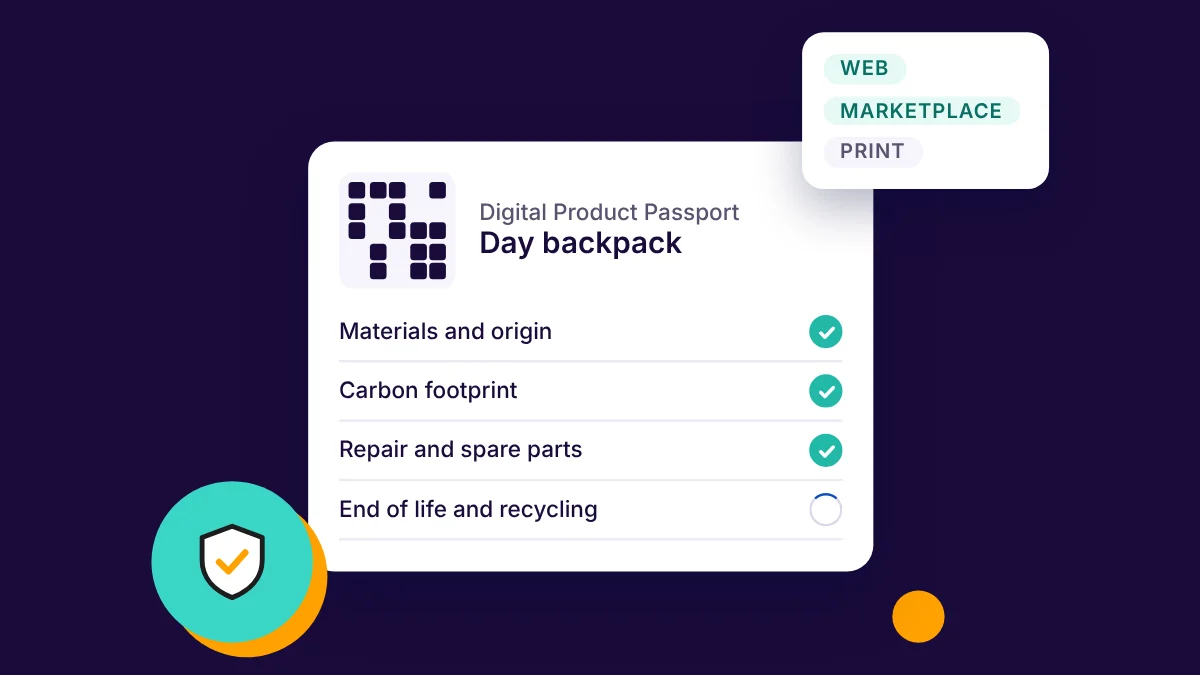
From 18 February 2027, an electric vehicle battery cannot be placed on the EU market without a battery passport. The same goes for an e-bike battery, and for any industrial battery above 2 kWh. That date sits in Regulation (EU) 2023/1542, and the European Commission’s Digital Product Passport Registry has been live since 20 July 2026. This is the first digital product passport that will actually bite. For almost every distributor and manufacturer we speak to, it is a data problem long before it is a compliance problem.
We say that first because the order matters. The legal reading takes a lawyer an afternoon. Getting your catalogue into a state where it can answer the questions takes a year.
The battery passport is an electronic record tied to a battery and reached through a data carrier, normally a QR code, on the product. Article 77 of the Batteries Regulation creates the obligation. Annex XIII sets out what goes in it.
Three things about it surprise people.
It is not a document. There is no PDF to email. It is structured data, held by you or a service provider, registered in the EU registry and read by machines.
It is not one audience. Annex XIII grades the information. Some fields are public. Some are for people with a legitimate interest and the Commission. Some are restricted to notified bodies and market surveillance authorities. One record, several views.
It is not a marketing asset. Nobody is going to admire your passport. It exists so a recycler in 2038 can work out what is inside a cell.
The wider framework behind all of this is covered on our digital product passport page, and the basics are set out in DPP fundamentals. This article is about the battery case specifically, because it is the one with a date on it.
The passport applies to three categories:
Portable batteries are out. Starter, lighting and ignition batteries are out. So the cordless drill pack on your shelf does not need a passport. The 5 kWh home storage unit next to it does. The e-bike battery does, whatever its capacity.
Now look at that list as a data question rather than a legal one. To sort your catalogue into “in scope” and “out of scope”, you need two things. Rated energy held as a number with a unit. Battery category held as a controlled value. Not free text. Not a phrase buried in a description.
Almost nobody has that. In the catalogues we audit, capacity turns up as “5kwh”, “5 kWh”, “5000Wh” and “5kWh (expandable)” in the same category. Once that is true, you cannot even produce the list of affected SKUs, let alone the passports. This is why we keep saying it is a data problem first.
The Commission groups the content into five areas:
Read that list slowly and you will notice how little of it is normal product data. Rated voltage and chemistry, you probably hold. Carbon footprint per manufacturing plant, recycled content per material, and state of health parameters, you almost certainly do not.
This is the part that changes your architecture, so it deserves its own heading.
Annex XIII separates information about the battery model from information about the specific battery in front of you. Chemistry, rated capacity and declared carbon footprint sit at model level. Manufacturing date and place, and the record of the unit over its life, sit at item level.
Your PIM is a model-level system. It holds the SKU, the attributes of the SKU, and the content that sells the SKU. It does not hold a row for unit number 4,318,229. Very few PIMs are built to, and forcing one to do it usually ends badly.
So the design decision is not “which PIM does battery passports”. It is where the serialised layer lives, and how it joins to the model layer through the identifier. Get that wrong and you will rebuild it in eighteen months. We work through that split with clients on our PIM solutions for DPP page.
Four things break in practice, and they break in the same order every time.
Attribute coverage. The fields do not exist in your schema. Carbon footprint per plant, recycled content shares by material, hazardous substances, durability parameters. None of these live in a standard distributor attribute set. They have to be designed, typed and scoped to the right categories before anyone populates anything. That is taxonomy and attribution work, not software configuration.
Units and types. Regulatory data has to be machine-readable. A field that accepts anything a buyer typed is not machine-readable. Every numeric attribute needs a unit of measure and a validation rule.
Provenance. Most of this data is not yours. It belongs to the cell manufacturer or the pack assembler. If your supplier onboarding today is a spreadsheet template emailed once a year, it will not produce carbon footprint declarations at plant level. Rewriting that request cycle is the longest lead time in the whole programme, which is why we treat supplier data onboarding as the critical path.
Identity. Model versus unit, as above. Plus the identifier question. The passport is reached through a unique identifier issued to recognised standards. That identifier has to be stable, unique, and reconciled with the part numbers already in your ERP.
There is one more trap worth naming. The obligation to create and maintain the passport sits with the economic operator placing the finished battery on the EU market. If you import battery packs from outside the EU, or you badge someone else’s product, that operator may be you rather than your supplier. We have seen distributors assume the manufacturer owns this, and find out late that they own it themselves. The obligation follows the product onto the market, not your postcode.
The passport is the shop window. The work sits behind it in three other obligations, and their timing is not equally settled.
Carbon footprint declaration. Article 7 requires a declaration for EV batteries, rechargeable industrial batteries above 2 kWh and LMT batteries, on a staggered timetable by category. Each stage depends on the Commission adopting a calculation methodology and a declaration format. Those acts have slipped repeatedly. Treat any specific date you read on a vendor blog as unconfirmed, and check the current position before you build a plan around it.
Supply chain due diligence. This covers cobalt, natural graphite, lithium and nickel. It was due to apply from 18 August 2025. Regulation (EU) 2025/1561 of 18 July 2025 pushed it back two years, to 18 August 2027. It also moved the deadline for the Commission’s guidelines to 26 July 2026. A further proposal to exempt companies below a set turnover threshold has been moving through the legislature. That one is a proposal, not law, so plan for the rule as it stands.
Recycled content. Disclosure obligations, then minimum shares, land later this decade rather than in 2027.
The pattern here is the useful bit. Dates move. Data does not. Every one of those obligations needs the same substrate: typed attributes, units, supplier provenance and a stable identifier. Build the substrate and the dates become an administrative question.
If we were running this for an electrical or industrial distributor, the sequence would be roughly this.
None of that is exotic. It is the same product data discipline we apply for electrical distributors who have been through ETIM classification. The difference is a new set of fields with a legal deadline attached.
The battery passport is the first real test of whether a catalogue can carry regulated data. The organisations that pass it in 2027 will be the ones that treated it as a schema and supplier problem in 2026. Want a second opinion on where your product data sits against the digital product passport requirements? Book a thirty minute call and we will walk through your affected categories with you.

Fill in your details and we will send it straight over.
What the Digital Product Passport asks of your product data, and how to prepare for it.

Talk to us about the product data you will need.